Various Modifications
of Amber
by Wieslaw
Giertowski
A
time of plenty and a time of a supply crisis
The 1990s
passed under the banner of intensive mining of raw amber.
Each year, the conglomerate in Yantarny on the western coast of the
Sambia Peninsula in the Kaliningrad Zone of the Russian Federation
increased its output, mainly thanks to the plentiful saturation with
amber (up to 6 kg per 1 m3) of the "blue earth" layer in
the Plazhova (Beach) strip mine. Until recently this small and shallow
strip mine produced about 70% of the global supply of raw amber. Unfortunately,
the mine was flooded in 2001. Now the Russian conglomerate has only
a single mine with an output that is three times lower, while being
very expensive to operate, because the mining work has to take place
over 55 metres below ground level.

The Russians have severely limited both legal and illegal exploitation
of other shallow deposits in Sambia and thus the supply of amber from
this richest of areas dropped from about 1000 tonnes per annum in
1996 to about 190 tonnes in 2004.
A dozen or
so years ago, an important role in the shaping of the market for the
raw material was played by the significant stock left over from the
amber product factory in Ribnitz-Damgarten in Mecklemburg, which operated
during the times of the GDR. Made from the raw material extracted
from the Goitsche Mine in Saxony, amber and its semi-products was
gradually sold until 2003.

An even greater role was played by the spontaneous rush to exploit
illicitly the rich and very shallow Ukrainian amber deposits on the
Volyhn-Polesie border. These deposits had been documented by geological
research in the early 1980s, which was a certain surprise for the
global amber economy. A large marshy area, covered with a sparse forests,
covers beautiful varieties of Baltic amber with an uncommonly large
granulation, very much in demand in the jewellery industry. Amber
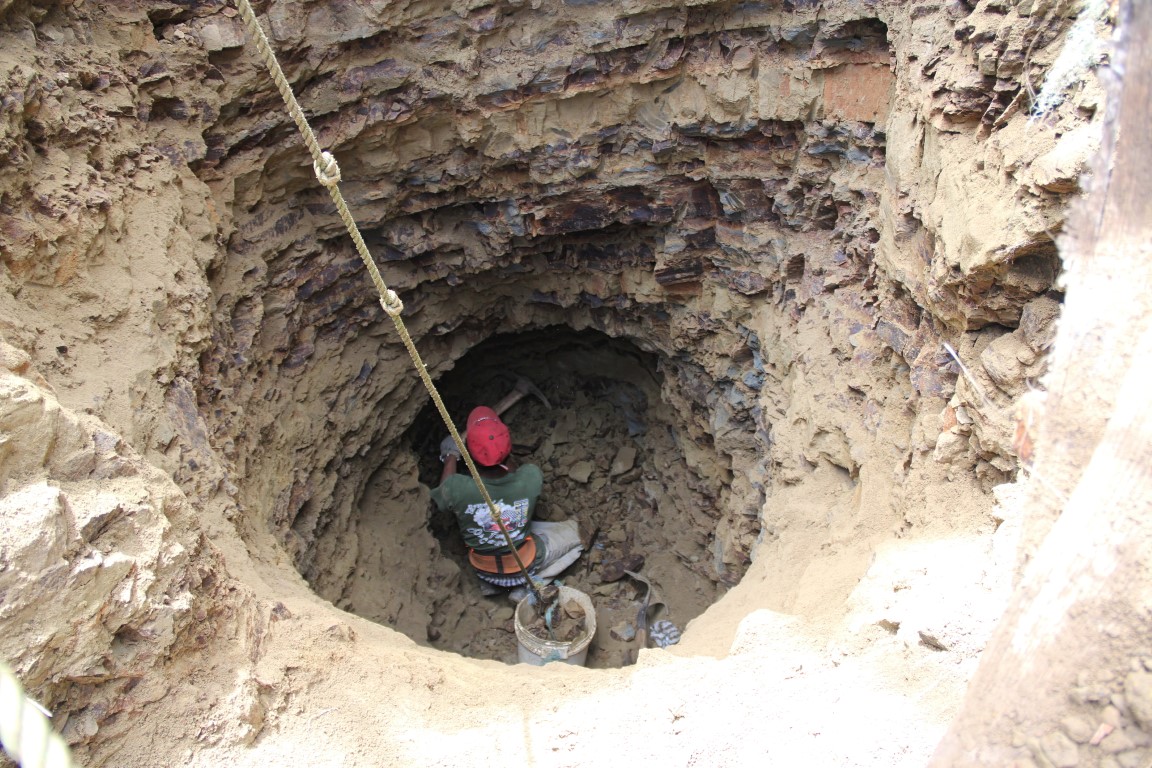
usually occurs here at a depth of 0.5 to 2 metres, which allows its
extraction using the simplest of tools, and the illegal diggers are
very difficult to catch under the cover of the forest.
The legal exploitation of these deposits somehow cannot get beyond
the experimental stage and it is still far from the result obtained
by the Germans in Goitsche Mine (about 50 tonnes per annum), although
a state-owned mining and processing conglomerate has been established.
Thousands of small digger teams will surely obtain a result which
is twice as great, as can be surmised considering the large share
of the characteristic Ukrainian amber in the supply of Polish and
Lithuanian studios. This share (in contrast to that of Russian amber)
is constantly growing.

Significant fluctuation, in turn, has taken place in the intensity
of the use of the amber deposits in the mining beaches in the Vistula
River Delta. In the first half of the 1990s, rapidly growing amber
processing led to the rise of numerous teams which used the hydraulic
method of rinsing amber out from under the sediment layers and a number
of others sought licenses for exploring and extracting. However, it
soon became apparent that given the strict Polish environmental protection
regulations, the costs of mining were much higher than the prices
offered by the suppliers from Russia and the Ukraine for raw material
specially selected for jewellery production. This was the reason for
limiting amber mining in the Vistula River Delta in spite of its unique
natural beauty. Only studios which focus on exclusive jewellery, and
use only fully natural stones, without any thermal improvement processes,
were ready to pay prices twice as high as those for the material from
the mines.

Following the flooding of the Plazhova Mine in Yantarny (2001), when
the prices of raw amber began to double each year, there was renewed
interest in obtaining licenses in the Vistula River Delta area and
unfortunately also a rise in illegal extraction in seaside forests.
The licensed
attempts to mine amber from the floor of the Gulf of Gda?sk had no
practical market impact. Two serious companies worked on this in 2003
and 2004 using two different methods of silting up the gulf floor
(with compressed air and with a jet of water under high pressure).
Unfortunately, without any success.
In summary,
it is worth noting that raw amber mining, which was at record highs
in the 1990s at a level of 900 to 1100 tonnes per annum, dropped in
2004 to about 300 tonnes. This has not yet led to any crisis in the
processing industry because most of the jewellery firms managed to
build considerable material stocks in the previous years. Furthermore,
fashion trends have led to the withdrawal of the most material-consuming
products (large necklaces, bracelets, statuettes and interior decoration
components) and their replacement with sophisticated gold and silver
jewellery with finely crafted amber gemstones.
However, in Poland, which is the main supplier of ready-made amber
products to the global market, we can see quite a steep drop in the
material stocks at a rate of 40-50 tonnes per annum, and the current
stocks remain at the threshold of the minimum level.
The
Classification of amber products and gemstones depending on the initial
raw material and the degree of their processing.
As a source material, amber has not yet been uniformly defined in
the classification recommended by CIBJO (Confederation Internationale
de la Bijouterie, Joaillerie, Orfeviere des Diamantes, Perles et Pierres).
Initially the name amber was attributed only to succinum i.e. Baltic
amber and other fossil resins coming from the same deposits for instance:
gedanite, stantienite and beckerite.
The introduction
in the 1950s of fossil resin from the eastern part of the Island of
Hispaniola, which is taken up by the Dominican Republic, under the
name of Dominican amber led to the giving of the name amber to other
fossil resins (over 1,000,000 years old) usually with a geographic
specification.
This is how the names of some of the resins used in the jewellery
industry came about:
- Sicilian amber- simetite
(from the name of the River Simeto in Sicily)
- Mexican amber- from
the state of Chiapas by the Gulf of Mexico
- Burman amber- burmite
- Canadian amber- cedarite
(from the name of Lake Cedar, where it occurs)
- amber from Borneo
- from Sarawak, the Malaysian part of the island.
In the sales structure in the market, products made of fossil resins
other that succinum do not play a major role - in total under 2%
in comparison with Baltic amber, and they are usually not a player
in the global market.
Of significant importance, however, is the lack of universally recognised
regulations as to the acceptability of marketing products made of
Baltic amber which are significantly modified using various physical
and chemical treatment. We can see two fundamental trends here:
the Polish and the Russian, (the Russian one also covers the former
republics of the Soviet Union: Lithuania, Latvia Byelorussia and
the Ukraine).
The Polish classification is based on the CIBJO principles. The
gemstones are divided into:
- natural - formed without any physical or chemical alterations
- improved - formed from thermally roasted nuggets
- reconstructed - pressed from small nuggets or amber meal
- doublets (triplets and further) - with at least a single layer of
natural amber.
Each of the above categories must be separately marked, and a single
product may not have a mix of components from different classification
categories. Furthermore, a principle to use the name amber only
in relation to Baltic amber (succinum) is respected (this principle
has also been expressed in German Law: in the Act of 4 May 1934
on the Protection of Amber, with amendments).
The Russian classification does not require the differentiation
of natural, improved, pressed amber or doublets, which may be combined
in a single products. It is characteristic to quote the introduction
to the article by V. Biernikov and V. Chistiakova on the structure
of the supply of the Russian market, published in the Yuvielirny
Mir -1998 annual:
"Comparatively small amounts of amber find their way to the
market in their natural form. Most of the raw material is subjected
to thermal treatment, clarifying, as well as various methods of
pressing in order to obtain a material with a uniform characteristic
intensely yellow tint, darker than that of natural [amber]."

This sentence is an accurate assessment only insofar as the market
of Russia and that of the former Soviet republics is concerned,
and not of the global market, which is oriented more towards the
Polish terminology.
The main difference consists in the way of approaching pressed amber.
The Russians, like the Germans before them, running large-scale
amber mining have a problem with finding use for small fractions
of the raw material, which due to its small size is unsuitable for
jewellery purposes. This is a problem of primary significance since
it concerns about 90% of the total mass of the raw amber obtained
from the mines.
In his fundamental book Yantar (Leningrad 1970), Prof. Sviatoslav
Savkiewicz, an experienced and reputable Russian amber researcher,
determined the proportions of the share of the individual fractions
on the basis of many years of observation of the quality structure
of the material which comes from the mine sorting plants, in the
following way:
1. raw jewellery-quality amber for export 2.5%
2. jewellery-quality amber for own processing in the conglomerate
7.5%
3. amber for pressing 30.0%
4. amber for chemical processing 60.0%
The above proportions have remained largely unchanged until today,
although the loosening of the discipline from the times of the totalitarian
system has led to the theft of the unique largest amber nuggets,
which may have led to a certain reduction in the share of jewellery-quality
amber (for a number of years no single nugget over 0.5 kg in weight
has found its way to the conglomerate's storehouse; while at the
same time the supply of such specimens has grown in the European
mineralogical exchanges).
The consequence of the above is the specific structure of the supply
of amber products on the internal market of the Russian Federation:
80% of the supply are products made of pressed amber, designated
identically to those made of natural nuggets. The extremely high
quality of some of the pressings makes them very difficult to differentiate
from products made of natural amber nuggets.
The problem
of what to do with the fine raw material fractions is practically
a non-issue in Poland and the Ukraine. The grains of amber washed
up from the sea and mined on the beaches of the Vistula River Delta
are fully used for the production of souvenirs and medicinal tinctures
with spirit. What with the illegal mining in the Ukraine, the fine
material is left in the earth.
Pressed
(reconstructed) amber
The property of Baltic amber, which has been well known for ages,
namely that it softens and becomes malleable in a temperature of 140-200oC
in an air-tight environment, became the basis for the attempts to
join together minute, irregular grains into large regular cylindrical
or plate-shaped forms, useful as semi-products for the most sought-after
objects: round or elliptical beads for necklaces, the walls of chests
or for once-fashionable mouthpieces for pipes and cigarette-holders.
The practical methods of pressing were invented in the Stantien &
Becker firm of Königsberg in the 1870s, and their names come
from the names of their inventors. The Spiller method was for obtaining
pressings in the shape of plates or opaque and semi-transparent blocks.
The Trebitsch method was much more complex and made it possible to
obtain cylinders of various thickness of completely transparent and
uniform material. These methods, shortly described below, are still
used today, although they have been improved and modified in various
ways.
In the Spiller
method, a cubicoid steel mould with a tightly fitting lid is filled
with very carefully selected amber (without any impurities of plant
remains), cleansed of its external weathered layer. This mould is
submerged in hot paraffin or glycerine in order to gradually heat
the amber charge in an air-tight environment, and then the charge
is pressed with a pressure of 400-500 kg per cm2 on the lid.
The Trebitsch method uses a double cylindrical mould, divided with
a barrier with capillary holes, through which the softened amber is
squeezed from the upper to the lower chamber, where the material is
rejoined into a fully uniform transparent mass. This operation requires
very high pressure, no less than 3000 kg per cm2. Good results are
obtained provided that the preselection of the charge material is
even more careful than when using the Spiller method.
The first industrial use of these methods took place in 1881 in Vienna,
which was then the centre of the production of amber tobacco smoking
accessories. This led to unexpected rise in this production.
It must be said of the Austrians, and later also of the Germans at
the Staatliche Bernstein-Manufactur Königsberg, that they honestly
marked the products made of pressed amber as Pressbernstein.
After the
German factory in Palmnicken was taken over by the Russians after
the Second World War and renamed as the Kaliningrad Amber Conglomerate
in Yantarny, work continued on the improvement of the technology of
pressing amber grains. Experiments were performed with varying degrees
of the amber granulation, the use of fillers and dyes, the atmosphere
of inert gases, raising the temperature and the heating time, as well
as the pressure. Today, amber is heated to as much as 220oC, while
the pressure varies between 2400 and 2700o kg/cm2.
Semi-products of varying quality are obtained depending on the type
of charge and the fillers and dyes added. Perfectly transparent, straw-
or honey-tinted pressed bars are made for the still sought-after necklaces
made of regular beads with faceted surfaces.

Similarly transparent material, albeit with the addition of a darker
pigment was used to reconstruct the rococo frame from the décor
of the walls of the Amber Chamber in Tsarskoye Selo. The engravings
and the intaglio made at the bottom of long (156 cm) semi-cylinders
in this frame look perfect.

The Amber Studio at Tsarskoye Selo, which specialises in the reconstruction
of artistic amber artefacts of the last few hundred years, uses many
varieties of pressed amber. An interesting example is the reconstruction
of the lost clock from the pre-World War II Königsberg collection
personally made by Alexander Krylov, the curator of the Amber Chamber.
It is worth noting the transparent shafts of the corner columns tinted
to various colours with the addition of pigments.
In Poland,
amber pressing never developed on an industrial scale. However, very
many small firms have made attempts to use this as a means of utilising
waste material from the mechanical processing of natural amber nuggets.
The result was a diversity of methods, and thus varying visual effects
and material properties.
The early
attempts at pressing from the turn of the 1950s and 60s were aimed
at producing a homogenous material, similar to that obtained using
the Trebitsch method. The results were usually inferior to those which
the Russians were obtaining at the time using the technologies of
the pre-World War II Königsberg plant. Pressing without an air-tight
environment led to a dark red tint and insufficient clarity of the
pressings. Necklaces made of these semi-products clearly differed
from those made of natural amber.
When pressing plates from amber granulate, even perfectly cleansed
of its external weathered layer, yielded material which was not uniform
with clearly visible borders at the joints of the charge grains. This
was the result of both the absence of air-tightness and insufficient
pressure (usually between 200-300 kg per cm2). Some customers liked
this effect and even today there is a market for this method of pressing.
A specific (and still used) method of pressing is the squashing of
the naturally irregular amber material softened at a temperature of
150-200oC into regular gemstones (cabochons, diamond shapes, sheets
- each stone from a single nugget). Such a material is almost impossible
to distinguish from natural or thermally improved amber. The last
2 years, which saw the pressure of the scarcity of natural amber,
led to attempts to press amber grains at a temperature close to the
threshold of the softening point (140oC), and even lower. This has
the aim to retain the specific tints and degree of transparency of
the components used.
We are dealing with two trends here:
1. to use other fossil resins occurring in the same deposits (e.g.
young amber, gedanite) or copals to fill in the spaces between the
decorticated pieces of succinite. The filling resins are low-melting
and tightly fill in the space between the amber fragments, permanently
binding them under pressure without changing the amber's appearance.
The amber fragments remain multicoloured which caused this method
of pressing to be dubbed as the "dappled" method.
2. to fill in the space between the fragments of natural amber with
finely ground amber powder and press everything under high pressure
at comparatively low temperatures. The pressed powder binds permanently,
but remains white and opaque, creating something akin to mosaic frames.
These diverse pressing methods have already found their market niches.
Just, as for instance, the "dappled" products which are
very popular in Italy.
A number of Polish amber jewellery producers have already mastered
the technologies modelled on that of the old German and modern Russian
traditions. These firms focus on producing precisely formed and calibrated
cabochons and regular necklace beads, which even have a certain advantage
over those produced from thermally improved nuggets, as the entire
material has a uniform "cognac" tint, not only a tinted
surface layer as is the case with the material roasted in autoclaves.
The current method of pressing used in Polish workshops makes it possible
to obtain the "scales" effect.
The
thermal improvement of amber
The correcting of the external appearance of ready-made products and
works of art made of amber through heating dates back to ancient times.
The method is inspired by natural phenomena. The amber which basked
on the beaches and dunes became clear and obtained an increasingly
intense hue.
Amber nuggets were thermally clarified and tinted in the Roman production
centre in Aquilea, and in the millennia that followed in the workshops
of the amber artists from the towns by the Baltic Sea, still unrivalled
in their artistic ingenuity and master craftsmanship. Each master
had his own recipe for improving nature in the desired direction.
However, these interventions were always comparatively mild and done
through the use of the slow heating of amber in liquids (usually oils)
or loose materials (sand or table salt).
It was only
in the 2nd half of the 20th century that a tool appeared, which was
as effective as it was risky. This tool is the pressure furnace filled
with inert gas: nitrogen or argon. In the air-tight chamber of the
furnace it is possible to quickly change the amber's bubbly structure
into a material which is clear but unfortunately has lost its natural
golden colour. We get a cold watery tint which is far removed from
tradition and customers' expectations.
The gas in
the furnace's chamber (called the autoclave) penetrates the amber's
structure at a pressure of 300 atmospheres and at a roasting temperature
of up to 300oC, altering not only its appearance but also its naturally
delicate and pleasant scent.
However, you do obtain the clarity and uniformity of the material
you want, and moreover the possibility of a second roasting with oxygen,
which allows you to give a fashionable colour to the surface and produce
the so-called scales, i.e. delicate, shiny cracks inside the gemstones.
Raw material, with the weathered layer, is processed in the autoclaves.
When viewed through a clarified layer of amber (for instance at the
bottom of cabochons), the weathered layer roasted in nitrogen has
a greenish tint. There are cases of saturating the weathered layer
with blue colouring which yields the effect of an intense green colour
when viewed through the yellowish amber. Not every seller is ready
to label this effect as artificial.
The vast majority of Polish amber product manufacturers do not improve
amber in autoclaves, feeling that this sort of intervention goes too
far. The unquestionable benefits such as: good clarity, the permanent
binding of the amber layers in the so-called splice (layering material),
increasing the hardness and decreasing the cleavage of the amber,
are accompanied by detrimental effects: discolouring and deterioration
of scent. These manufacturers use the old methods of roasting in liquids,
sand, salt or even in furnaces with the access of air, through slow
heating and subsequent cooling. The lesser degree of clarification
yielded by this method is offset by the retaining of the natural colour
in the entire structure of the amber nuggets.
Comparing
the effects of improvement (roasting) and reconstruction (pressing)
The International Amber Association allows recommended firms to sell
products made of roasted amber, but does not permit pressed, i.e.
reconstructed amber. This principle stems from the idea to retain
the initial form of the nuggets when they are improved, while in the
process of pressing we are dealing with the destruction of this form.
All other organisations of manufacturers deem both methods as acceptable.
Infra-red absorptive spectroscopy (IRS), the most reliable method
for the identification of Baltic amber, does not indicate any differences
between the natural, improved and reconstructed (pressed) material,
which shows that all the particles which form the amber remain unchanged.
This observations will surely become the basis for discussion on the
purposefulness of using various processing methods in the coming future,
when we will face a severe shortage of raw material.
In the long
run, however, the solution will be to intensify the exploitation of
amber deposits, which according to the geological research are very
abundant and give the prospect of supplying amber product manufacturers
with amber for as many as thousands of years.

Photographs:
1. Wieslaw
Giertowski
2. The beach mine in Yantarny on the western shore of the Sambia Peninsula
3. The flooded beach mine
4. View from the Goitsche Mine before mining was discontinued
5. Amber mining from the shallow Ukrainian deposits in Volyhn
6. Typical specimen of natural amber from the mining beaches of the
Vistula River Delta
7. Figurine of a bull made of pressed amber from Yantarny
8. Viennese cigarette-holder made of pressed amber from the end of
the 19th century
9. Detail of a necklace made of transparent pressed amber with faceted
surface.
10. Clock from the lost Königsberg collection reconstructed by
A. Krylov
11. Detail of a necklace pressed in Poland in the 1970s
12. Detail of a necklace made of "dappled" pressed amber
13. Detail of a necklace made of pressed amber powder
14. Detail of a pressed necklace with the "scale" effect
1
1b
2
3
4
5
6
7
8
9
10
Blue Amber
| Green Amber |
Feather |
Millipedes
| Spiders
| Books
| Loupes
Expensive Amber
| Unique Amber
| Pseudoscorpions
| Botanicals in Amber
Candy Amber
| Amber Cam
| Baltic Amber
| Black Lights
| Amber Chunks
Amber Medicine
| Chiapas Amber
| Malaysian Amber
| Kauri Gum
| Specials
Mounted Bugs
| Jewelry
| Fake Amber
| Bug Specials
| Newsletter
| FAQs
| Copal
Free Screen Saver
| Gift Certificate
| Field Guide
| Unpolished Kauri
| Weather
Testimonials
| General Info
| Amber Poster
| Rough Amber
Postage for amber will usually cost $4.80 (USD) per order, anywhere in the world. There may be exceptions to this. We will get your sample
to you as soon as possible (usually mailed the same day or at worst, the next day). U.S. orders
go out by Priority Mail, overseas as Air Mail. Books are normally mailed "Media Mail", unless they are light, in which case they are mailed first class.
Overseas books are air mail unless the weight is prohibitive, in which case you will have the option of surface (ship) or paying a bit extra for air mail.
All prices are in U.S. dollars. If you are overseas and want something other than normal air mail - contact us when you make the purchase.
For any questions, please contact us at sales@ambericawest.com.
Our emails are sent immediately, so if you don't receive it, it is likely caught in a spam filter. You will receive another email when your order ships which will contain the shipping information.
You
can pay 3 ways, either by credit card (located on each page as the 'buy now' button), a personal
check,
or purchase order.
Finally, if you feel more comfortable, feel free to call us at 719-488-2654 (this is in the United States). This number works as a fax if you would like to fax your request or purchase order.
Interested in a gift certificate for your daughter or son or that
special person? Why not try our gift certificates?